

Purpose of the Certification
This certification teaches professionals at all levels of management how to apply the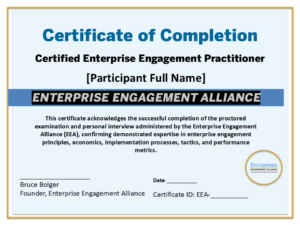 proven principles of Total Quality Management (TQM) to the engagement of all stakeholders to achieve clear, measurable organizational or team purpose, goals, objectives, and values.
These enterprise engagement principles apply to the design, implementation, and measurement of any type of leadership, engagement or other activity in business or life that requires harmonizing the interests of all stakeholders for optimal results.
Participants learn how to use a long-proven disciplined, transparent, and evidence-based approach to design strategies and tactics that align the interests of all relevant stakeholders to achieve clear results. These enterprise engagement principles can be applied to any organized effort—in business, government, not-for-profit organizations, and even in family or personal goal setting.
The focus is not on theory alone, but on practical application: how to design, implement, measure, review, and continuously improve engagement efforts intended to produce reliable and meaningful outcomes.
This certification is designed to build credible, practical capability—not ideology, tactics in isolation, or short-term programs. It reflects the application of Total Quality Management (TQM) principles to the realities of managing people, stakeholders, and performance in complex systems.
Click here to compare this education program with others on the market in terms of focus, content, and applications in management and life.
Click here for a Power Point that summarizes the program.
The Applications
TQM is a systematic, holistic approach engagement to achieve any type of organizational, team, professional or personal purpose, goals, objectives, and values.
Sales
- Align sales activity to clearly defined customer value and purpose
- Standardize best-practice sales processes while enabling continuous improvement
- Use measures beyond revenue (cycle time, win consistency, customer trust)
- Improve forecast accuracy and reduce variability in performance
Marketing
- Clarify purpose, target audiences, and value propositions before tactics
- Treat campaigns as systems with feedback loops, not one-off initiatives
- Align stakeholders (sales, partners, customers) around shared outcomes
- Measure what matters: impact, not just impressions or clicks
Leadership
- Create clarity of purpose and priorities across teams
- Align strategy, execution, and measurement into a single operating system
- Reduce risk by replacing ad-hoc decisions with predictable processes
- Build a culture of learning, accountability, and continuous improvement
Human Resources / People Management
- Align talent, incentives, development, and engagement to organizational purpose
- Define roles, expectations, and success measures clearly
- Improve onboarding, performance management, and retention through systems thinking
- Shift from programs to sustained capability building
Personal Life
- Clarify purpose, values, and success criteria for major life decisions
- Align family or personal stakeholders around shared goals
- Reduce stress and conflict through clear roles, routines, and communication
- Learn from experience and make better decisions over time
What You Will Learn
This study guide outlines what candidates are expected to understand to achieve basic certification in engagement. The emphasis is on general comprehension and applied judgment, not technical specialization or rote memorization. Certified practitioners will be able to:
- Explain the logic and value of TQM-based stakeholder management to boards, senior leaders, colleagues, or students
- Design transparent engagement operating systems and processes aligned with purpose, goals, objectives, and values of an organization, team, or project
- Evaluate tactics and metrics for alignment and effectiveness
- Use data and structured feedback to support continuous improvement
Overview: A Systems-Based Approach to Achieving Purpose
Candidates will learn a strategic and systematic approach to achieving purpose, goals, objectives, and values—drawing on the same management principles used daily in manufacturing plants, laboratories, and engineering organizations worldwide.
While these principles are widely used in operational environments, they are rarely taught in traditional business education, particularly as they apply to people, stakeholders, and engagement. This certification focuses on the knowledge practitioners need to:
- Present a credible, evidence-based framework to decision-makers, colleagues, employees, and students
- Apply TQM principles to real organizational, team, or even personal challenges
- Adapt the same structured approach across different sectors and settings
Candidates are tested on their understanding of these principles and their ability to apply them appropriately in different contexts.
General Concepts and Historical Foundations
To apply TQM principles credibly, practitioners must understand their origins and intellectual foundations. Candidates will develop a working knowledge of:
- The historical roots of Total Quality Management and enterprise engagement
- Why these principles emerged and how they were validated through practice
- The contributions of key thinkers such as W. Edwards Deming, Peter Drucker, R. Edward Freeman, Leonard Schlesinger Jr., the Gallup Human Sigma research, etc.
- Early organizational practitioners that demonstrated these principles in action (e.g., Costco, Whole Foods, Delta Airlines)
This knowledge enables practitioners to clearly distinguish TQM-based stakeholder management from informal, ad hoc, or purely cultural approaches by grounding discussions in systems-thinking, economics, and evidence.
Economics and Impact Measurement
Because stakeholder-related decisions often compete for resources, certified practitioners must understand how to articulate economic value based on research and measurement, not assumption or platitudes. Candidates will demonstrate a general understanding of:
- Why economic evidence matters in stakeholder-related decisions
- The difference between inference and research-supported claims
- Basic principles of impact measurement
- The role of Statistical Process Controls (SPCs) in monitoring and improving performance
- Harmonizing stakeholder interests through better alignment of engagement and enablement tactics
The emphasis is on knowing when and why these tools are used, rather than mastering the technicalities of each one.
Stakeholder Inter-Relationships
A defining feature of stakeholder management is understanding how different stakeholder groups experience and influence an organization or process. Candidates will be expected to understand:
- The general interests of different stakeholder groups, including:
- Customers
- Sales and non-sales employees
- Distribution and supply chain partners
- Communities, volunteers, or other relevant groups
- How stakeholder interests can align or conflict
- Why unmanaged tradeoffs often undermine performance
- How structured approaches help harmonize interests over time
The focus is on systems awareness, versus advocacy for any single stakeholder group.
Engagement Process Design
Applying TQM to stakeholder engagement requires a transparent and disciplined design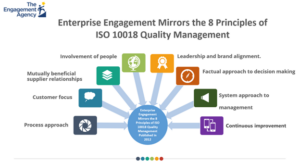 process. Candidates will learn how engagement efforts are structured to include:
- A clearly defined purpose, goals, objectives, and values
- Identification of key stakeholder groups and their interests
- A process for gathering structured input
- Selection and alignment of tactics
- Clearly defined metrics and measurement methods
- Deployment schedules, review cycles, and accountability
- A documented continuous improvement process
Candidates will be tested on their understanding of the Nominal Group Technique and their ability to describe, at a high level, how to design an engagement effort for virtually any organizational or team objective.
Tactics, Integration, and Alignment
While no professional can be an expert in every tactical discipline, effective stakeholder management requires a general understanding of how major tactics fit together. Candidates will demonstrate familiarity with:
- Brand architecture (purpose, goals, objectives, values applicable to all stakeholders and investors)
- Leadership development
- Business operating systems
- Recruitment and onboarding
- Stakeholder voice mechanisms
- Communications (digital, print, face-to-face, experiential)
- Job design and work environments
- Diversity, equity, and inclusion (DEI)
- Incentive programs
- Loyalty strategies
- Rewards and recognition (appreciation, cash, merchandise, travel, gift cards)
- Analytics
- And more
The emphasis is on integration and alignment, not just tactical execution.
Metrics, Measurement Systems, and Reporting
Measurement and reporting are essential to any TQM-based effort. Candidates will demonstrate a general understanding of:
- The purpose of metrics and measurement systems
- How metrics support decision-making and improvement
- Differences between internal and external reporting
- The existence and intent of major reporting frameworks and standards, including:
- GRI
- ISSB
- ISO
- CSRD
Candidates are not required to memorize standards but be able to name the major ones, their general purpose, and must understand why they exist and how they are used.
Continuous Improvement
Continuous improvement is central to applying TQM to people and stakeholder management. Candidates will understand:
- How feedback and measurement inform improvement in a business operating system
- Why engagement efforts are iterative, not one-time initiatives
- The importance of documenting assessments and changes
- How learning is embedded into ongoing management processes
Optional Special Focus Areas
Candidates seeking to demonstrate deeper expertise may select or propose a special focus area within enterprise engagement. Standard options include:
- Sales employees
- Non-sales employees
- Customers
- Channel partners
- Rewards and recognition
Test Methodology
The certification test assesses a candidate’s knowledge and fundamental grasp of applying TQM principles to stakeholder engagement. The test is designed to:
- Evaluate understanding and applied judgment
- Reduce the likelihood of cheating using AI or other methods
- Ensure consistency and credibility across candidates
Certification Options
1. Certified Engagement Professional
Demonstrates clear proficiency in core concepts.
- 90-question multiple-choice live, proctored exam (taken in two parts)
- Five-question oral exam via recorded Zoom
- Optional audience specialty with an additional 50-question exam
- Fees: $250 per exam; $100 additional per specialty exam
2. Advanced Certification
Demonstrates the ability to design and explain stakeholder engagement programs.
- One-hour recorded Zoom session
- Candidate applies the TQM framework to a real organizational challenge
Fee: $500 every three years
- Fellow of Enterprise Engagement
Recognizes sustained applied expertise and leadership. Requirements include:
- Completion of all prior certifications
- Five years of relevant professional experience
- 30-minute interview and documentation review
One-time Fee: $500 every three years
Educational Support
To make the program accessible globally, the EEA offers multiple learning paths.
- EEXAdvisors. A self-directed option including:
- A complete series of articles and resources suitable for preparation
- A structured study guide aligned with the exam
2. Books
Books can be purchased individuall
3. Academy Membership (Individual, Corporate, Solution Provider)
Depending on membership level–individual, corporate, and solution provider, benefits include:
- A selection of books covering stakeholder engagement
- Nine decks for self study
- Nine recorded expert video discussions
- A 50-question practice exam
- Free content from the Stakeholder Management Library for Leaders, Academics and Investors
All paid members receive a complimentary 15- 30minute Q&A session for program preparation.
Corporate and solution provider members receive a 45-to 60-minute group training program
Click here for Enterprise Engagement Impact Academy pricing details and to register for the program of your choice.